Monday, March 22, 2010

Alchemy Shaped Chemistry

Dr. Frankenstein took a great interest in alchemy growing up. When he attended Ingolstadt he was told by his professor that studying alchemy was a waste of time. But was it a waste of time? Alchemists tried to turn base metals into gold. Although they were unsuccessful, it is very impressive idea to experiment with considering the little knowledge of atoms and elements at that time. It is because people think "outside the box" that they come up with new discoveries. Because of all their effort they happened to produce inorganic acids, techniques of fusion, calcination, solution, filtration, crystallization, sublimation, and distillation. Read more: http://www.chemistryexplained.com/Te-Va/Transmutation.html#ixzz0ixGyBbAu
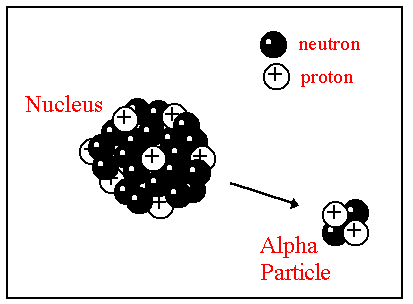
Also, Alchemists' ideas were not completely ridiculous. Some radioactive elements do actually transform into different elements. Radioactive decay causes the nucleus to emit energy, sometimes they emit a proton. A change in the number of protons yields a change in element. We may not be able to change base metals into gold, but I believe alchemists were on the right track.
-Elana

Friday, March 19, 2010

Mythology Inspires and Creates


The story of Frankenstien draws a lot of comparission to Galatea a statue from the greek mythology of Metamorphoses X. The myth talks about how aphrodite brought the statue of Galatea to life for Pygmalion. Aftering seening woman prositute themselves he could not fall in love he made this statue admiring its beauty gave up all his time and bought it gifts until Aprhodite out of pity brought it to life. Much like Dr. Frankenstein who gave up all his time to creating the monster, he seeked a companion an did all he could to obtain it.Its very possible Mary Shelley was inspired by this tale as well since it featured an inadmit object becoming lifely and seeking compansionship as the man in the tale who eventually married the once statue and had a child with it. Frankensteins creation also seeked a companion different from the rest, it contrast the tale in that he was rejected when he came to life while the statue was all that Pygmalion ever wanted when he created it.
By Ronald Delio Rodriguez EN102

Thursday, March 18, 2010

A Modern Twist


Frankenstein is also referred to as The Modern Prometheus. Reading Frankenstein I kept on wondering what exactly is The Modern Prometheus. Well, it is a Greek Myth where Prometheus created mankind. He also secretly stole fire from heaven and gave it to man. What Mary Shelley did was create man through a modern level with electricity.

An Interesting Secret


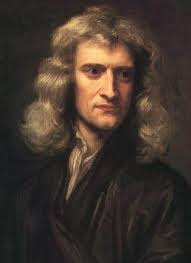
The famous scientist Sir Isaac Newton was born on January 4 and died on March 31 1727. He was a English physicist, mathematician, astronomer, natural philosopher, alchemist, and theologian. What is so interesting is that he was at the time a secret alchemist. Being a scientist you look for reasons and explanations to your findings. As a alchemist you believed in magic and the search of the philosopher's stone which would cure all diseases and prolong life indefinitely. This is a belief in the supernatural, as we know that living forever is not possible. A man of modern science and a natural philosopher you don't rely on the use of "magic" in your scientific findings.

Friday, March 12, 2010

Heinrich Cornelius Agrippa

Heinrich Cornelius Agrippa
Born14 September 1486
Cologne, Germany
Died18 February 1535 (aged 48)
Grenoble, France
Cause of deathUnknown
Occupationmagician, occult writer,theologian, astrologer, alchemist,physician, legal expert and soldier

Agrippa was born in Cologne in 1486. In 1512, he taught at the University of Dole in France, lecturing on Johann Reuchlin's De verbo mirifico; as a result, Agrippa was denounced, behind his back, as a "Judaizing heretic." Agrippa's vitriolic response many months later did not endear him to the University.

In 1510, he studied briefly with Johannes Trithemius, and Agrippa sent him an early draft of his masterpiece, De occulta philosophia libri tres, a kind of summa of early modern occult thought. Trithemius was guardedly approving, but suggested that Agrippa keep the work more or less secret; Agrippa chose not to publish, perhaps for this reason, but continued to revise and rethink the book for twenty years.

During his wandering life in Germany, France and Italy he worked as a theologian, physician, legal expert and soldier.

He was for some time in the service of Maximilian I, probably as a soldier in Italy, but devoted his time mainly to the study of the occult sciences and to problematic theological legal questions, which exposed him to various persecutions through life, usually in the mode described above: He would be privately denounced for one sort of heresy or another. He would only reply with venom considerably later. (Nauert demonstrates this pattern effectively.)

There is no evidence that Agrippa was seriously accused, much less persecuted, for his interest in or practice of magical or occult arts during his lifetime, apart from losing several positions. It is impossible of course to cite negatively, but Nauert, the best bio-bibliographical study to date, shows no indication of such persecution, and van der Poel's careful examination of the various attacks suggest that they were founded on quite other theological grounds.

It is important to mention that, according to some scholarship, "As early as 1525 and again as late as 1533 (two years before his death) Agrippa clearly and unequivocally rejected magic in its totality, from its sources in imagined antiquity to contemporary practice." Some aspects remain unclear, but there are those who believe it was sincere (not out of fear, as a parody, or otherwise).[1] Recent scholarship (see Further Reading below, in Lehrich, Nauert, and van der Poel) generally agrees that this rejection or repudiation of magic is not what it seems: Agrippa never rejected magic in its totality, but he did retract his early manuscript of the Occult Philosophy -- to be replaced by the later form.

According to his student Johann Weyer, in the book De praestigiis daemonum, Agrippa died in Grenoble, in 1535.

After Agrippa's death, rumors circulated about his having summoned demons. In the most famous of these, Agrippa, upon his deathbed, released a black dog which had been his familiar. This black dog resurfaced in various legends about Faustus, and in Goethe's version became the "schwarze Pudel" Mephistopheles.

Mary Shelley mentioned Agrippa in some of her works. In her 1818 gothic novel Frankenstein, Agrippa's works were read and admired byVictor Frankenstein. In her 1833 short story "The Mortal Immortal", Agrippa is imagined as having created an elixir allowing his apprentice to survive for hundreds of years.

Galvanism

A scientist named Luigi Galvani studied static electricity. He discovered when you apply a spark to a dead frog the muscles twitch! Luigi described this as animal electricity, but it is also referred to as Galvanism.
Check out this cartoon representation from Wikipedia applying galvanism to a human:
This is a pretty similar idea to Frankenstein.
-Elana


Ronald Delio Rodriguez


3/12/10 EN102


Blog on Frankenstein using Albertus Mangus


Albertus Magnus who lived from ca. 1193/1206- November 15th 1280 was a bishop who advocated for the coexistence of science and religion. He was a self taught natural scientist and was involved in the discovery of the philosopher’s stone, and with this he created metals and materials unknown to this world. One specifically was a project he named android which was given speech, taught and even a soul supposedly. The project was destroyed by a student of his who claimed it to be a diabolic being. Upon reading this I reflected back to the story I read by Mary Shelley called “Frankenstein” were she mentions one of Frankenstein’s influences in creation was Mangus. Mangus was considered the greatest philosophers and theologian of his time during the Middle Ages before the story was written so it is very possible he influenced her in writing the story. She talks about making an artificial being threw lab experiments which is the exact same thing Mangus was said to have done. The path of her story was very similar to his as well, in that Frankenstein and the android were both rejected upon creation. I found this part very interesting and the way it was done as well in that they both used strange materials in their creations. Today in day I am sure many people are still trying to create an artificial being, much progress has been made threw science to achieving it. Robots as of now are the first step.

Thursday, March 11, 2010

A Change In Thinking To natural science


Frankenstein first followers in science were those who were known to believe in magic and the supernatural. Scientists such as Paracelsus, Albertus Magnus, and Cornelious Agrippa were major influences on Frankenstein. So, what changed his interest to natural science? Frankenstein observed a storm where he saw "a stream of fire issue from an old and beautiful oak tree". The oak tree was completely destroyed. This astonished him, and he asked his father how did this happen? His father replied"electricity". According to
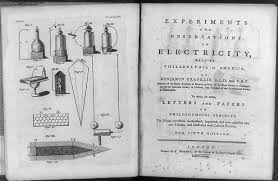
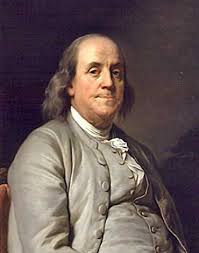
in 1751 Benjamin Franklin published “Experiments and Observations on Electricity" which described Franklin's ideas about the nature of electricity and how electrical devices worked, and new experiments to investigate lightning. Experiments summarized in this booklet determined the existence of positive and negative charges, and the difference between insulators and conductors. This work led to the invention of the lightening rod. Benjamin Franklin a founding father of the constitution, someone we all are familiar with led Frankenstein to change his thinking, and beliefs.
-Elie-

Wednesday, March 10, 2010

Darwin's impact on Frankenstein

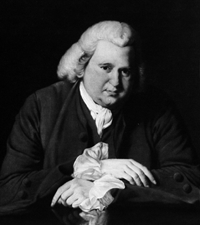
Frankenstein is like a brief compilation of emerging scientific ideas of the late 18th/ early 19th century. Erasmus Darwin (mentioned in the preface; photo on left) from what I have found, is believed to have had a major impact on Mary Shelley's Frankenstein. According to http://www.uh.edu/engines/faust.htm she had read Dr. Darwin's ideas of generating life from rotting foods. Darwin was amazed at the idea that worms could emerge from rotting foods. Of course now we know foods don't produce worms, but at that time, they must have thought anything could be possible. Thus, Mary Shelley played with the idea of creating life.

Also, Erasmus basically outlined the idea of transmutation of species; which later inspired his grandson, Charles Darwin (the Father of Evolution) to write the origin of species. This was completed in 1859, after the completion of Frankenstein. So this idea of mutating species and where life comes from must have been an upcoming popular idea!
-Elana